# Settlements - Summary
The **Settlements** tab in cairo.BI is a **tool for monitoring the company’s receivables and liabilities**. It enables **full control over payments** and **helps assess their impact on the company’s financial liquidity**.
In this tab, users can analyze, among other things:
\- **receivables and liabilities balance** – the company’s current financial balance,
\- **overdue items** – breakdown of settlements by delay periods,
\- **payment schedule** – forecast of future receivables and liabilities over time,
\- **settlements by contractors** – analysis showing which business partners generate the largest receivables and liabilities,
\- **settlements by currencies** – control of balances in PLN, EUR, USD, and other currencies,
\- **settlements by settlement groups** – overview of settlements within defined categories.
The **Settlements** tab in cairo.BI allows for quick identification of potential risks related to payment delays and assessment of the company’s financial stability. It is a key tool supporting liquidity management and strategic financial decision-making.
All values are converted to PLN according to the **exchange rate of the previous day**, ensuring consistent presentation regardless of the document currency.
[](https://help.cairo.pl/uploads/images/gallery/2026-04/x6TVNBYDViyYt0RF-image.png)
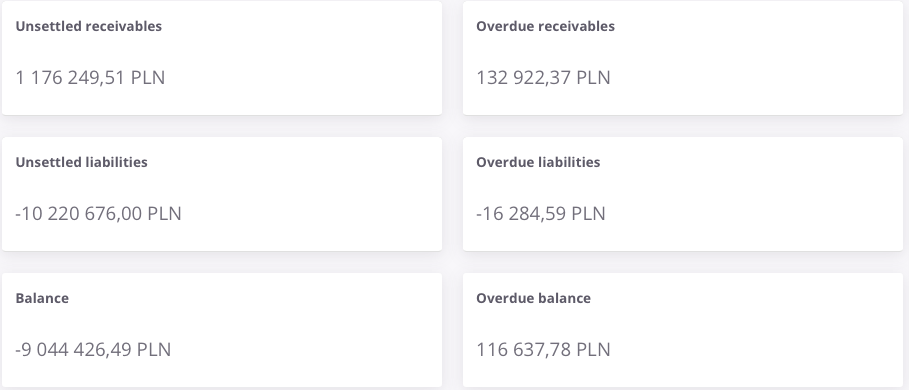
The section presents the **key values of receivables and liabilities in a general view**. It shows both current and overdue amounts.
The visible fields are:
- **Unsettled receivables** – the current value of receivables from contractors that have not yet been paid.
- **Overdue receivables** – the portion of receivables for which the payment deadline has been exceeded.
- **Unsettled liabilities** – the company’s current obligations that have not yet been settled.
- **Overdue liabilities** – liabilities for which the payment deadline has passed.
- **Balance** – the difference between unsettled receivables and liabilities.
- **Overdue balance** – the difference between receivables and liabilities, taking into account only overdue amounts.
Thanks to this section, the user can quickly **assess the current state of settlements** and determine whether the company currently has a **surplus of receivables or liabilities**.
---
[](https://help.cairo.pl/uploads/images/gallery/2026-04/3eUE5NI8sFHXEPIk-image.png)
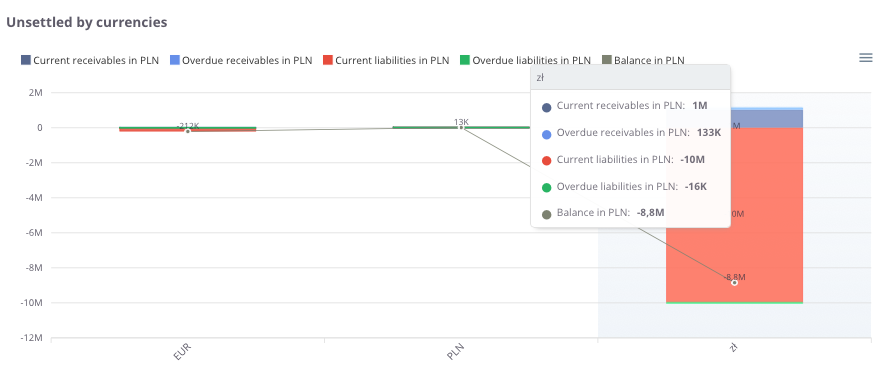
**“Unsettled by currencies”** – the chart presents the **value of unsettled receivables and liabilities broken down by currency**.
The following elements are visible:
- **Current receivables in PLN** – amounts for which the payment due date has not yet passed,
- **Overdue receivables** **in PLN**– amounts past their payment due date,
- **Current liabilities in PLN** – amounts payable to suppliers before the due date,
- **Overdue liabilities in PLN** – amounts past their payment due date,
- **Balance in PLN** – the difference between receivables and liabilities in a given currency.
---
### Unsettled values by currencies – table
[](https://help.cairo.pl/uploads/images/gallery/2026-04/LiH7cpiGuoR8yhgv-image.png)
**“Unsettled values by currencies – table”** – this summary presents **receivables and liabilities broken down by individual currencies**. For each currency, the following data is displayed:
- **Currency** – Indicates the currency in which the settlements are recorded.
- **Receivables** – Displays the total current value of receivables in the specified currency.
- **including overdue** – The portion of receivables that has exceeded the payment due date.
- **Liabilities** – Displays the total current value of liabilities in the specified currency.
- **including overdue** – The portion of liabilities that has exceeded the payment due date.
- **Balance in currency** – The net difference between total receivables and total liabilities for that currency.
- **Receivables in PLN** – The total value of receivables converted into PLN.
- **including overdue** – The value of overdue receivables converted into PLN.
- **Liabilities in PLN** – The total value of liabilities converted into PLN.
- **including overdue** – The value of overdue liabilities converted into PLN.
- **Balance in PLN** – The final financial balance for the specific currency, converted into PLN.
The table uses **color highlighting**:
- **Red bar** – its length reflects the volume of liabilities; the longer the bar, the higher the total amount payable.
- **Grey bar** – its length corresponds to the volume of receivables; the longer the bar, the higher the total amount due.
This allows the user to quickly assess not only numerical values but also **the proportions between receivables and liabilities in each currency**, as well as the **impact of delays on the balance**.
The table includes a **search field**, which allows narrowing the data to selected currencies. In such cases, **summaries automatically adjust** to the filtered results.
Additionally, data can be **sorted by clicking column headers** – for example, to arrange currencies by the amount of receivables, liabilities, or balance.
---